

Wine tourism
Bourgueil · Chinon · St Nicolas
REF: 343
Buying an organic wine estate is often more than a professional project: it is a conviction, a major life decision.
It means choosing to cultivate vines differently, with patience, understanding, and exacting standards. If you hold this long-term vision, rooted in the land and mindful of future generations, and are now seeking an estate that reflects your values, Ampelio is here to guide you.
Ampelio support you throughout your search to help you find a property that truly aligns with your goals.

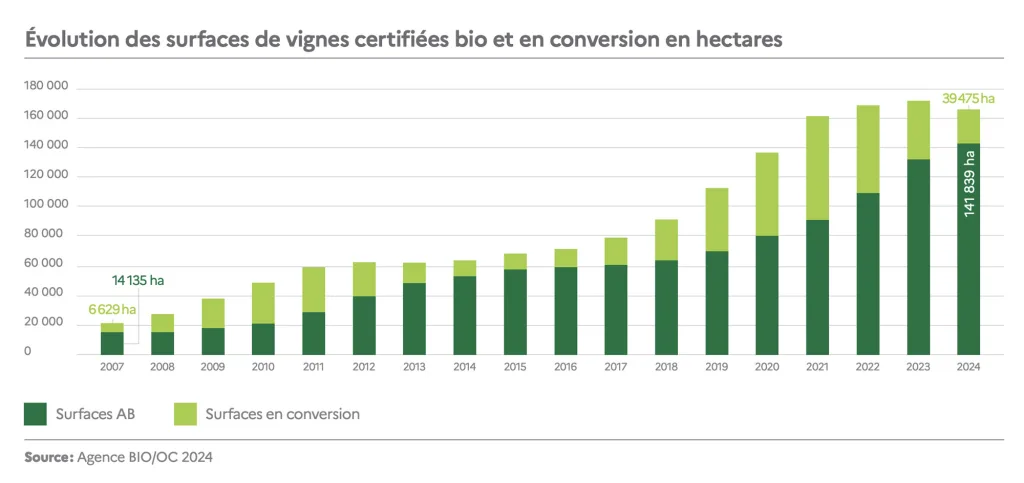
In 2024, France counts 141,839 hectares of organically farmed vineyards, along with 39,975 hectares in conversion. For the first time after years of steady growth, a slight decline has been recorded: a 4% decrease in certified organic acreage, with the share of organic vineyards within the national vineyard area dropping from 22% to 21%.
The regions of Occitanie, Nouvelle-Aquitaine, and Provence–Alpes–Côte d’Azur (PACA) alone represent over 70% of all organic vineyard surfaces. While Occitanie and Nouvelle-Aquitaine show significant decreases, the PACA region continues to expand (+4%).
At the same time, organic viticulture is steadily emerging across the northern half of the country, particularly in Bretagne, Normandy, and Île-de-France, where areas under organic cultivation are growing rapidly, even if volumes remain modest for now.
Nevertheless, the market for organic wine estates remains active, attracting increasing interest from buyers committed to sustainable practices.
Source : Agence Bio – Bilan 2024
Evolution of Certified Organic Vineyard Areas and Land Under Conversion (in hectares)
The Loire Valley stands out as one of the most dynamic wine regions in France when it comes to sustainable farming practices.
In 2024, 85% of Loire wine estates are engaged in an environmental approach, whether through organic farming (AB), biodynamics, or certifications such as HVE or Terra Vitis.
Among them, 25% of estates are certified organic or in conversion, a figure that has risen sharply in recent years. Between 2019 and 2022, the number of certified estates increased by 50%, accompanied by a 44% rise in organically farmed vineyard area.
This rapid growth highlights the strong commitment of Loire winegrowers to more environmentally respectful viticulture.
The region’s emblematic appellations: Chinon and Saumur-Champigny: are leading the movement, with 38% and 34% of their vineyard areas converted to organic farming, respectively.
“Organic farming has become a defining feature of Loire Valley viticulture, particularly for red wines, which are driving this momentum,” notes Terre de Vins in its analysis of the sector.
Source : Terre de Vins – Dynamique bio en Val de Loire
A specialist in vineyard transactions in the Loire Valley for over 10 years, Ampelio supports both sellers and buyers in projects with strong environmental value.
Today, 41% of the estates currently for sale through Ampelio are certified organic, biodynamic, or in conversion. This figure reflects the evolution of buyer expectations, as more and more investors are attentive to environmental issues and the quality of vineyard practices.
Since the agency’s creation in 2012:
20% of the estates sold were organic or biodynamic
Since 2020, this share has risen to 26%
41% of the wine estates supported by Ampelio follow a sustainable viticulture approach (HVE certification, organic, or biodynamic)
With an in-depth understanding of the local market and a strong network of committed winegrowers, Ampelio has become the preferred partner for buying or selling organic wine estates in the Loire Valley.
Viticulture today offers a wide range of labels, each reflecting a specific approach to environmental stewardship and wine quality. From regulatory organic standards to more committed initiatives, these labels help distinguish different levels of requirements and practices.
Organic Farming (France & Europe)
The French AB label and the European Euroleaf symbol are the most widely recognized certifications for organic farming. They guarantee the absence of synthetic chemical inputs (fertilizers, herbicides, pesticides), prohibit GMOs, and restrict certain oenological practices (such as sulfites and additives). These labels ensure environmentally respectful viticulture, backed by national and European regulatory frameworks.
Nature & Progrès
This French association-based label, which predates AB, is both an organic certification and an ethical charter. It imposes stricter standards than AB, both in the vineyard and in the cellar, while also integrating social, economic, and human values (solidarity, autonomy, short supply chains). Although less widespread commercially, it is highly regarded by environmentally conscious consumers.
Biocohérence
Created by French producers seeking to go beyond official organic standards, Biocohérence builds upon the European organic framework and adds reinforced criteria: 100% French origin, stricter traceability, and social requirements (employment, governance). It positions itself as a more demanding and locally focused alternative to the AB/Euroleaf certification.
Demeter
Demeter is the international benchmark for biodynamic certification. It builds on organic requirements but goes further by mandating biodynamic preparations, adherence to lunar and planetary cycles, and highly regulated winemaking practices. It is considered one of the strictest and most respected agricultural labels worldwide.
Biodyvin
Biodyvin is a certification specifically for winegrowers practicing biodynamics. It focuses exclusively on viticulture and vinification. Its specifications are rigorous, and the label is particularly well-regarded among renowned wine estates.
AVN (Association des Vins Naturels)
AVN is not an official label but an association that brings together winemakers committed to producing “natural wines.” The principles include organic or biodynamic farming, manual harvesting, spontaneous fermentation without additives, and no use of oenological inputs (except possibly a minimal amount of sulfur). It is a qualitative designation recognised by natural wine enthusiasts.
SAINS (Sans Aucun Intrant Ni Sulfite)
This collective promotes an extremely strict standard: zero additives, including zero sulfur. SAINS wines rely solely on the grape, with no additions in the vineyard or the cellar. It is a radical approach, valued by a niche audience seeking the purest expression of natural wines.
V-Label
This international label is not specific to viticulture but applies broadly to vegetarian and vegan food products. When used on a wine, it guarantees the absence of animal-derived substances traditionally used in fining. It meets the growing demand for wines compatible with vegan diets.
HVE (High Environmental Value)
This French environmental certification has three levels, with Level 3 being the highest. It is not equivalent to organic farming, as it allows the use of phytosanitary products, but it rewards biodiversity preservation, water management, and reduced inputs. HVE is widely adopted in viticulture.
Terra Vitis
A private label dedicated to sustainable viticulture, Terra Vitis covers vineyard management, environmental impact, and social responsibility. It offers a more flexible framework than organic standards but is more structured than conventional farming. Terra Vitis promotes “sustainable viticulture,” balancing production with respect for the natural environment, and enjoys strong recognition within the wine industry.